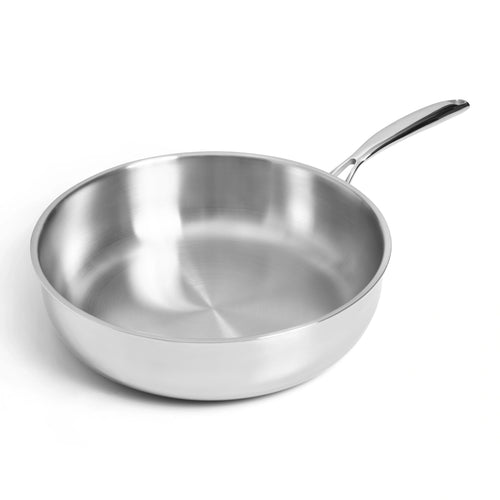
Stainless Steel Skillets

If you could pick just one pan for everyday cooking, a stainless steel sauté pan would be a strong contender. The high rim makes room for stir-fries, sauces, risotto and one-pan meals, while the stainless steel gives meat and vegetables a crust you rarely get from a coated pan. And because there's no non-stick coating to age or get damaged, the pan keeps performing the same year after year. In Culicartel's stainless steel sauté pans collection you'll find stainless steel sauté pans from Demeyere, Le Creuset, KitchenAid, Skottsberg and DUCQ, all suitable for induction.

Read blog

Cast iron pans

A heavy and durable material, resistant to high temperatures. The pan lasts for generations. These pans don't warp and are oven-safe. Heating up and cooling down takes a bit longer, but once hot it stays hot for a long time. Don't wash the pan in the dishwasher.

Carbon steel pans

Lighter than cast iron and they heat up faster. These pans are seasoned to create a non-stick layer. Warm the pan up after washing to dry it completely. This prevents rust.

Stainless steel pans

Stainless steel is very light and doesn't rust. These pans are also dishwasher-safe. They can withstand high temperatures but cool down quickly.

Copper pans

These pans don't just look stylish, they're also very durable. Good copper unfortunately doesn't come cheap, but the quality is fantastic. Working on professional dishes like sauces, jam or risotto where you need perfect temperature control? Then the copper pan is the perfect choice.

Aluminium pans

At a lower price you give up some quality, but they're very pleasant to use. They're light pans that are easy to clean. They have excellent heat conduction and are therefore ready to use quickly.

Filter

Sort

Frequently asked questions

  • What is the difference between a skillet and a saute pan?

    The two look very similar and are often used interchangeably. The classic distinction lies in the sides: a saucepan has slightly flared or rounded edges, making it easy to scoop and stir, while a sauté pan has straight, vertical sides that retain moisture better for dishes such as stews. In practice, the names overlap; Le Creuset, for example, also calls its Provençal sauté pan a saucepan. So pay close attention to the base diameter, capacity, and whether a lid is included, rather than the name on the box.

  • Why does food keep sticking in my stainless steel frying pan?

    Almost always because the pan was not yet at the right temperature when the food was added. First, heat the empty pan for a few minutes over medium heat and test it with a few drops of water: if they roll around the bottom like little silver beads, the pan is ready. Only then add the oil and let it heat up as well. Next, place the meat or fish in the pan and leave it alone: it will release naturally as soon as a crust has formed. Turning it too soon and using a pan that is too cold are the two main culprits. Explained step by step in the blog cooking without sticking in a stainless steel pan.

  • Where do those blue or rainbow-colored spots on my stainless steel saucepan come from?

    That is what is known as heat tint: a paper-thin layer of oxidation that forms when stainless steel is heated intensely, for example after preheating the pan empty or searing over high heat. It is completely harmless and says nothing about the quality of the pan. If you want to remove the stains, wipe the cooled pan with a splash of white vinegar or lemon juice and rinse; the steel will be silver-colored again. A stainless steel cleaner also works. The discoloration has no effect on the taste or safety of your food.

  • Is a stainless steel frying pan suitable for induction?

    Yes, all the stainless steel saucepans in this collection have been checked for induction compatibility. Good to know: the 18/10 stainless steel of the cooking surface itself is barely magnetic; the reason induction still works is due to the magnetic steel layer on the underside of the multi-layer base. Brands like Demeyere even developed their bases specifically for high energy transfer on induction. In addition, the pans work perfectly fine on gas, ceramic and electric stoves. You can also find all the induction-compatible models in the saucepans for induction.

  • What size stainless steel sauté pan do I need?

    For two to three people, Ø24 cm is sufficient, with a capacity of around 2.8 to 3 liters. If you are cooking for a family or like making one-pot meals, choose Ø28 cm; depending on the series, that is around 4 to 5.7 liters. For large groups or those who like to cook in large quantities, there is Ø30 cm. With induction, also pay attention to your cooking zone: a pan that is much larger than the zone heats up more slowly at the edges.

  • What does tri-ply mean, and what do 5 or 7 layers add?

    Tri-ply means that the pan consists of three layers: stainless steel, a heat-conducting aluminium core, and a magnetic steel layer for induction. This already provides fast, even heat distribution, which is more than sufficient for everyday use. In 5- and 7-ply pans, such as the Demeyere Industry 5 and Atlantis 7, there are additional layers of aluminium and sometimes copper, in the top series extending all the way through the walls. You notice the difference mainly with precision cooking: sauces, delicate dishes, and long simmering at a constant temperature.

  • Can a stainless steel sauté pan go in the oven?

    Stainless steel sauté pans are generally oven-safe; handy if you start a dish on the stove and let it finish cooking in the oven. However, pay attention to the lid and handles: a glass lid or a plastic lid knob often withstands less heat than the pan itself. Therefore, always check the maximum oven temperature for the specific model before placing the pan, lid and all, in the oven.

  • How do I remove burnt-on residue from my stainless steel saucepan?

    Add a layer of water to the pan and bring it to a boil: the burnt-on residue will loosen, and you can then easily scrape it away with a wooden or silicone spatula. For stubborn deposits or dull patches, use a special stainless steel cleaner. Avoid steel wool and abrasive scouring pads, as they will scratch the polished surface. Also, let the pan cool down before rinsing it; this prevents warping due to thermal shock.

  • Can a stainless steel saucepan go in the dishwasher?

    Uncoated stainless steel is dishwasher-safe, so most stainless steel saucepans can go in without any problems. To preserve the shine, we recommend hand washing; harsh dishwasher tablets can dull the steel over time. If your pan has a ceramic non-stick coating on a stainless steel base, it is best to wash it by hand to preserve that coating. Uncoated stainless steel is also completely PFAS-free; if you want to make a conscious choice in this regard, take a look at the PFAS-free saucepans.

  • Which stainless steel saucepan is best for beginners?

    Start with a solid tri-ply pan, such as the KitchenAid Tri-Ply Stainless Steel or the Skottsberg Stainless Steel: a stable base, suitable for all heat sources and easy to maintain. If you enjoy cooking in stainless steel, then a 5- or 7-ply Demeyere such as the Industry 5 or Apollo 7 is the logical next step; you will probably never replace such a pan. If you are unsure, our specialists are happy to help you in the store, via WhatsApp or via chat.

What you need to know about Stainless Steel Skillets

What is a stainless steel sauté pan and when should you choose one?

A sauté pan is somewhere between a frying pan and a saucepan in terms of shape: the base is wide enough for frying, while the sides are significantly higher than those of a frying pan. This makes it easy to stir without spilling and allows you to continue with a sauce, curry, or pasta in the same pan after browning. This is where stainless steel really shines. Stainless steel does not rust, does not react with acidic ingredients such as tomatoes or wine, can withstand intense heat, and leaves a brown residue (fond) on the base that you can loosen with a splash of liquid to create the base of a rich sauce, a process known as deglazing. While a non-stick coating needs replacing after a few years, a good stainless steel pan will last for decades with proper care. If you are still unsure whether a sauté pan is the right type for your cooking style, read our blog which pan do I need? or view our full range of sauté pans.

What should you look for when buying a stainless steel sauté pan?

Start with the base. Stainless steel is naturally a poor heat conductor, so premium brands sandwich an aluminium or copper core between layers of steel. In a tri-ply (3-layer) pan, this core is in the base; in 5- and 7-layer pans, the heat-conducting layers extend into the walls in the better models, so the entire pan heats evenly and hot spots are eliminated. As a rule of thumb, choose Ø24 cm (around 2.8 to 3 litres) for two or three people, Ø28 cm (depending on the model, around 4 to 5.7 litres) for a family, and Ø30 cm if you like cooking large portions or for guests. If you also want to be able to stew and braise, choose a model with a lid from the sauté pans with lids collection. All stainless steel sauté pans at Braadbaas have been checked for induction compatibility and also work on gas, ceramic and electric hobs. You can find more information about materials in the blog what material should I buy pans in?

The stainless steel saucepans from the brands at Braadbaas

Demeyere sets the tone with this collection. You will encounter the Belgian brand in professional kitchens worldwide, and that is reflected in the technology. The Apollo 7 and Atlantis 7 are made of seven metal layers (7-PlyMaterial) with the InductoSeal base, in which a copper disc is hermetically encapsulated for fast, even heat distribution right to the edge; the Silvinox surface treatment keeps the steel silver-white even after years. The Industry 5 is the 5-layer entry-level model from the brand, and if you want a lid, look at the Intense 5, the Silver 7 with a double-walled lid or the Fusion 7 with a glass lid. In all Demeyere series at a glance we present the differences clearly side by side. If you are looking for an affordably priced introduction to stainless steel, the KitchenAid Tri-Ply Stainless Steel and the Skottsberg Stainless Steel are the logical starting points, both with a solid tri-ply base. Le Creuset, on the other hand, serves the stylish top segment with the Classic 3-ply line, with the Provençal sauté pan of Ø30 cm and the clever saucepan with poaching insert. If you cook on a downdraft extraction system in the countertop, the DUCQ Downdraft Stainless Steel is specially designed for that; in the blog pans for downdraft extraction systems you can read what to pay attention to.

How to get the most out of your stainless steel saucepan

Stainless steel requires just one habit that a coated pan does not know, and that is preheating properly. Place the empty pan on medium heat and perform the water test after a few minutes. Let a few drops of water fall into the pan: if they sizzle away immediately, the pan is still too cold; if they roll around the bottom like silver beads (the Leidenfrost effect), you have reached the right temperature. Only then add oil or butter, let the fat heat up and add your ingredients. Meat sticks slightly at first and releases on its own as soon as a crust has formed; if you wait for that moment, frying in stainless steel is just as easy as in a pan with a coating. The full technique is explained in the blog frying without sticking in a stainless steel pan. Maintenance is simple: boil off burnt-on residue with a little water, polish dull or discolored steel with a stainless steel cleaner, and avoid steel wool because it scratches the polished surface. Uncoated stainless steel is dishwasher safe, although hand washing preserves the shine the longest; if a model has a ceramic top layer, wash it by hand. Read more tips in how do I maintain my pans?