Demeyere Sauté Pans

For many serious home cooks, a Demeyere sauté pan is the pan that's on the hob most often: wide enough to stir-fry in, deep enough to gently reduce a sauce and built to last for decades. At Culicartel you'll find the full range of Demeyere sauté pans, from the accessible Alu Pro 5 Ceraforce with PFAS-free ceramic coating to the multi-layer stainless steel top models Apollo 7 and Atlantis 7. Below you can read what each model does best, so you quickly know which one suits your way of cooking.

Read blog

Cast iron pans

A heavy and durable material, resistant to high temperatures. The pan lasts for generations. These pans don't warp and are oven-safe. Heating up and cooling down takes a bit longer, but once hot it stays hot for a long time. Don't wash the pan in the dishwasher.

Carbon steel pans

Lighter than cast iron and they heat up faster. These pans are seasoned to create a non-stick layer. Warm the pan up after washing to dry it completely. This prevents rust.

Stainless steel pans

Stainless steel is very light and doesn't rust. These pans are also dishwasher-safe. They can withstand high temperatures but cool down quickly.

Copper pans

These pans don't just look stylish, they're also very durable. Good copper unfortunately doesn't come cheap, but the quality is fantastic. Working on professional dishes like sauces, jam or risotto where you need perfect temperature control? Then the copper pan is the perfect choice.

Aluminium pans

At a lower price you give up some quality, but they're very pleasant to use. They're light pans that are easy to clean. They have excellent heat conduction and are therefore ready to use quickly.

Filter

Sort

Frequently asked questions

  • What is a sauté pan and what do you use it for?

    A sauté pan is a wide, deep pan with high, straight sides. It is one of the most versatile pieces of cookware in the kitchen: you can use it for baking, stir-frying, stewing, reducing sauces, and even cooking pasta. Thanks to the combination of a large cooking surface and deep sides, a sauté pan is ideal for dishes with many ingredients, such as mash, curry, risotto, or stews. A Demeyere sauté pan is specifically designed to tackle those tasks with professional precision, even at home.

  • Why does food stick in my stainless steel Demeyere saucepan?

    Usually, it’s the temperature, not the pan. You need to preheat stainless steel properly. Heat the empty pan gently over medium heat and perform the water test: if drops of water dance around the bottom like little beads, the pan is ready for the oil. Pat your ingredients dry, leave them alone for a moment after adding them, and the crust will release on its own as soon as it’s cooked. Turning them too early or using a pan that isn’t hot enough are the two biggest causes of sticking. That way, you’ll never have to worry about cooking with stainless steel again.

  • What makes Demeyere frying pans better than many other brands?

    Demeyere stands out with its base and surface technology. While many brands attach a separate sandwich base to the pan, Demeyere builds a fully integrated multilayer construction (5 or 7 layers) that distributes heat very evenly, with an encapsulated copper disc in the InductoSeal base on the top series. In addition, the Silvinox surface treatment is special: it keeps the stainless steel silver-white and easy to clean even after years of use. Demeyere pans are made in Belgium and meet high professional standards.

  • Are Demeyere frying pans suitable for induction?

    Yes. All Demeyere saucepans in the Braadbaas range are suitable for induction, as well as gas, electric, ceramic and halogen. The fully enclosed, multi-layer base has been specially developed for high energy transfer on induction, allowing the pan to heat up quickly and evenly. When using induction, heat the pan gradually to prevent thermal shock. You can find all induction-compatible models in our induction saucepans.

  • What is the difference between the Apollo 7, Atlantis 7 and Industry 5?

    The Atlantis 7 and Apollo 7 both feature a 7-ply construction for the most even heat distribution. The Atlantis 7 is the heaviest and highest-quality model with the best heat retention; the Apollo 7 is slightly lighter and more affordably priced. The Industry 5 has a 5-ply construction: lighter and more competitively priced, making it an ideal, affordable entry point into the brand rather than a heavier pro pan. In short: choose the Atlantis 7 for maximum performance, the Apollo 7 for the right balance of performance and weight, and the Industry 5 as an accessible stainless steel all-rounder.

  • Can a Demeyere sauté pan go in the dishwasher?

    The stainless steel Demeyere frying pans are generally dishwasher-safe, but hand washing is recommended to optimally preserve the shine and the Silvinox finish. The Alu Pro 5 Ceraforce with ceramic coating is best washed by hand to preserve the non-stick coating. If you do use the dishwasher, choose a mild program; harsh tablets can dull stainless steel over time.

  • Which size Demeyere sauté pan do I need?

    As a rule of thumb, a 24 cm frying pan is suitable for 2 to 3 people, while a 28 cm pan is ideal for 4 or more. Also consider the capacity in liters: a 24 cm pan usually holds around 2.8 liters, while a 28 cm pan holds between 4.7 and 5.7 liters, depending on the series. If you regularly cook large portions or want enough room for braising, choose the 28 cm model.

  • How long does a Demeyere frying pan last and what is the warranty?

    With proper care, a stainless steel Demeyere frying pan will last for decades. On the uncoated stainless steel series, such as the Atlantis 7, Apollo 7, Industry 5, Silver 7, Intense 5 and Fusion 7, Demeyere offers a 30-year warranty against manufacturing and material defects. For the ceramic-coated Alu Pro 5 Ceraforce, there is a 5-year warranty on the coating. The warranty does not cover damage caused by overheating or improper use, and hand washing is recommended to maintain your warranty coverage.

  • Is a Demeyere frying pan worth the investment?

    For those who take cooking seriously and are looking for a pan that will last for decades, a Demeyere saucepan is a wise investment. Because the pans do not wear out quickly when properly maintained, the cost per year of use remains relatively low. You are paying for a fully integrated multi-layer base, excellent heat distribution, and the durable Silvinox finish. View the full range on the Demeyere saucepans-page, or compare with other brands on our Stainless steel saucepans page.

  • Can I use metal kitchen utensils in a Demeyere saucepan?

    You can use metal utensils without any problems in the stainless steel Demeyere frying pans (such as Apollo 7, Atlantis 7, Industry 5, Silver 7, Intense 5 and Fusion 7); stainless steel is well resistant to this. Do be careful with the ceramic-coated Alu Pro 5 Ceraforce: preferably use wood, silicone or plastic, so that the non-stick coating stays in good condition for as long as possible.

  • What is the difference between a sauté pan and a braising pan?

    A sauté pan has high, straight sides and a wide base, ideal for stir-frying, stewing, and preparing sauces and one-pot dishes. A roasting pan usually has lower, slightly flared sides and is primarily intended for searing meat and slow cooking. Simply put: if you mainly use a pan for sauces, stir-frying, and stews, a sauté pan is the right choice; if you primarily want to sear meat, choose a roasting pan. Demeyere offers both types at Braadbaas. If you are still unsure, read which pan do I need?

What you need to know about Demeyere Sauté Pans

What is a sauté pan and why Demeyere?

A sauté pan has high, straight sides and a wide, flat base. This combination makes it ideal for dishes where you prepare many ingredients at once without them falling out of the pan: from stir-fries and curries to risotto and stews. Demeyere, the Belgian brand from Herentals that you have been encountering in professional kitchens for decades, stands out above all for its base technology. The stainless steel Demeyere sauté pans are constructed from multiple metal layers, depending on whether it is the five- or seven-layer series, so that heat is distributed evenly right to the edge of the pan. This allows you to sear meat beautifully and cook sauces gently without hotspots or burning. If you want to browse more broadly first, view all sauté pans or read in our blog which pan do I need?

The Demeyere sauté pan range at Braadbaas

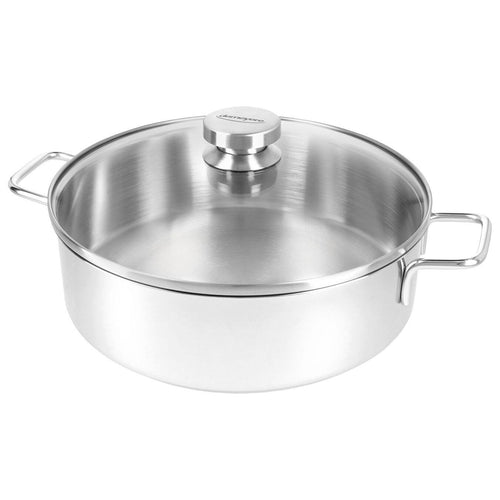
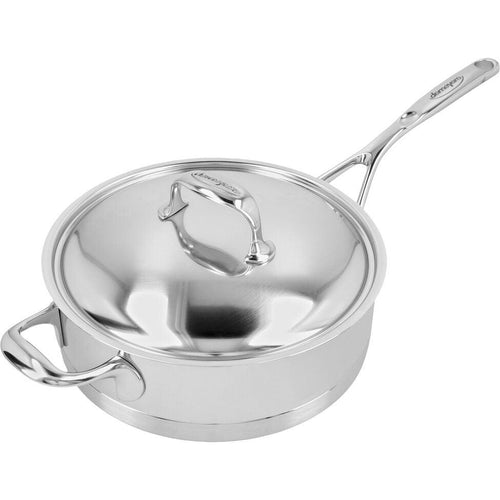
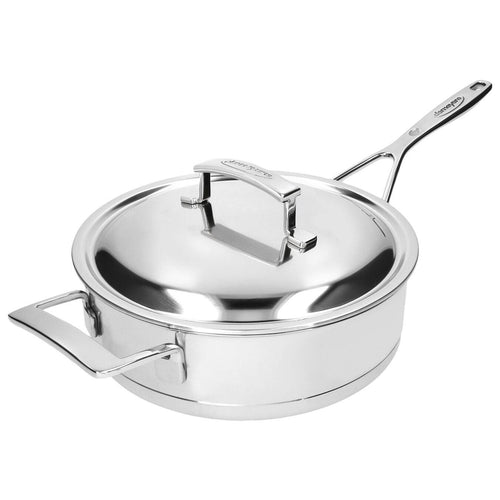
In the Braadbaas range you will find various Demeyere sauté pans, each from its own series with its own characteristics. The Apollo 7 and Atlantis 7 are the stainless steel top models with a 7-layer construction for even heat distribution on induction and gas. The Industry 5 is the more affordably priced 5-layer variant: lighter in use and a nice first step into the brand. If you are looking for a complete pan including the lid, then the Intense 5 with lid or the Silver 7 with double-walled lid is a nice choice, and the spacious Fusion 7 comes with a glass lid. Are you looking for a sauté pan with a non-stick coating? Then the Alu Pro 5 Ceraforce with PFAS-free ceramic coating is your best choice, ideal for delicate dishes such as fish or eggs. Most models are available in Ø24 and Ø28 cm; some, such as the Intense 5 (Ø24 cm) and the Fusion 7 (Ø28 cm), in one size.

Material and technology: why stainless steel is the basis

Most Demeyere sauté pans are made of polished stainless steel (RVS), a material that has been preferred by professional chefs for centuries. Stainless steel does not react with acidic ingredients such as tomatoes or lemon juice, can generally go in the dishwasher and lasts a lifetime with proper care. Demeyere goes beyond standard stainless steel. The patented Silvinox-treatment removes iron and impurities from the surface, so the outside remains silky smooth and silver-white, fingerprints are less visible and the pan remains beautiful even after years of use. For heat distribution, Demeyere uses technologies such as the 7-PlyMaterial (seven metal layers) and the InductoSeal-base, in which a copper disc is hermetically encapsulated for greater, even heat conduction and efficient cooking on induction. That saves cooking time and energy. In addition to sauté pans, you will find the same build quality in the Demeyere frying pans and Demeyere cooking pans.

Which Demeyere saucepan is right for you?

The right choice depends on your cooking style, your budget and the heat source in your kitchen. Do you cook daily for the whole family and want a pan that will last a lifetime? Then the 7-ply Atlantis 7 and Apollo 7 are the best choice; the Atlantis 7 is the heaviest, highest-quality model, while the Apollo 7 is slightly lighter and more affordably priced. Do you want a sturdy stainless steel saucepan without immediately spending the maximum budget? Then the 5-ply Industry 5 is an excellent, lighter entry-level option. Do you like a pan that you can take straight from the heat with a lid on and put on the table, then look at the Silver 7 or Fusion 7. And if you prefer working with a non-stick coating, choose the PFAS-free Alu Pro 5 Ceraforce. Still unsure about the material? Our blog what material should I buy pans in? will help you, and our customer service team is happy to help you over the phone, WhatsApp or email.

How to cook without sticking in your stainless steel Demeyere

The most common question about stainless steel pans is why food sometimes sticks, and almost always it is due to the temperature, not the pan. Stainless steel needs to be preheated. Heat the empty pan gently on medium heat and do the water test: let a few drops of water fall into the pan. If they evaporate immediately with a hiss, the pan is not yet ready; if the drops dance around like little mercury balls, the pan has reached the right temperature and you can add the oil. Pat meat and fish dry beforehand, place them in the hot pan and leave them alone for a while: a crust will release itself from the bottom as soon as it is cooked enough. If you poke it too early, you will tear the crust and it will stick. After frying, a little water or vinegar in the hot pan (deglazing) effortlessly loosens the browned bits, providing the basis for a delicious sauce. Read more maintenance tips in how do I maintain my pans?

Induction, gas or oven: Demeyere can handle it all

All stainless steel Demeyere saucepans in the Braadbaas range are suitable for induction as well as gas, electric, ceramic and halogen. The base technology really comes into its own on induction: the flat, fully enclosed base directly picks up the magnetic field and distributes the heat right to the edge of the pan, which saves cooking time and energy. The stainless steel models are also oven-safe, handy if you start a dish on the stove and let it finish cooking in the oven; check the specific model for the exact maximum oven temperature, as a glass lid or lid knob may have a lower limit. The ceramic-coated Alu Pro 5 Ceraforce is light and easy to use, but requires slightly more restraint with heat than bare stainless steel. If you want to see all induction-compatible models side by side, check out our saucepans for induction or the full brand on the Demeyere-page.