Ceramic Appetizer Pans

Looking for a ceramic sauté pan that's light to use, easy to clean and induction-ready? At Culicartel you'll find ceramic sauté pans from Greenpan, Demeyere, Le Creuset, Smeg, DUCQ and BK. They all have a ceramic non-stick coating free of PFAS, PFOA, lead and cadmium, and work on induction, gas, ceramic and electric hobs. Below you can read how ceramic compares to a traditional coating, where each brand shines and which pan suits your way of cooking.

Read blog

Cast iron pans

A heavy and durable material, resistant to high temperatures. The pan lasts for generations. These pans don't warp and are oven-safe. Heating up and cooling down takes a bit longer, but once hot it stays hot for a long time. Don't wash the pan in the dishwasher.

Carbon steel pans

Lighter than cast iron and they heat up faster. These pans are seasoned to create a non-stick layer. Warm the pan up after washing to dry it completely. This prevents rust.

Stainless steel pans

Stainless steel is very light and doesn't rust. These pans are also dishwasher-safe. They can withstand high temperatures but cool down quickly.

Copper pans

These pans don't just look stylish, they're also very durable. Good copper unfortunately doesn't come cheap, but the quality is fantastic. Working on professional dishes like sauces, jam or risotto where you need perfect temperature control? Then the copper pan is the perfect choice.

Aluminium pans

At a lower price you give up some quality, but they're very pleasant to use. They're light pans that are easy to clean. They have excellent heat conduction and are therefore ready to use quickly.

Filter

Sort

Frequently asked questions

  • What is a ceramic frying pan and how does it differ from a regular non-stick pan?

    A ceramic frying pan has a non-stick coating based on ceramic material (silicon) instead of a traditional PFAS-containing coating. The big difference is that ceramic is free of PFAS, PFOA, lead, and cadmium. In terms of ease of use, they are similar: both have a good non-stick effect, are easy to clean, and require little oil or butter. Ceramic is generally a bit more sensitive to overheating and abrasive use, so cooking at moderate heat and hand washing will keep the coating looking good for the longest time.

  • Are ceramic frying pans PFAS-free and safe?

    Yes. The ceramic saucepans in the Braadbaas range have a coating that is free from PFAS, PFOA, lead and cadmium. This applies to the coatings of, among others, Greenpan (Thermolon) and Demeyere (Ceraforce), and to the ceramic pans from Le Creuset, Smeg, DUCQ and BK. This makes them a conscious choice for everyday use. If you want to be sure that a specific pan is PFAS-free, this is stated on the product page; you can find all pre-checked options grouped under the PFAS-free saucepans.

  • Are your ceramic frying pans suitable for induction?

    The ceramic frying pans in this overview are suitable for induction and also work on gas, ceramic and electric hobs. They have a flat, magnetic base that is directly picked up by the induction field. Heat the pan gently on induction to prevent thermal shock. To be safe, always check the induction symbol on the product page of the specific model. If you want to see all induction-suitable models side by side, check out our frying pans for induction.

  • Why does my ceramic pan still start sticking over time?

    This is the most common question about ceramic pans, and usually, the pan itself isn't the problem. The two biggest causes are overheating and using aerosol cooking sprays. At excessively high temperatures, the non-stick coating weakens, and sprays leave behind an invisible layer of residue that builds up and actually causes sticking. Therefore, cook over low to medium-high heat, use a little regular oil or butter instead of spray, and wash the pan by hand. Does the pan still stick? A paste of baking soda and water gently lifts stubborn residue without damaging the coating.

  • How long does a ceramic frying pan last?

    That depends heavily on use and care. A ceramic coating gradually wears down due to heat cycles and lasts on average less long than a PFAS layer, but with careful use, cooking on low to medium-high heat, hand washing, no metal utensils and not dry heating, the coating will last beautifully for several years. Models with an extra wear-resistant coating, such as the Greenpan Barcelona Pro, are better resistant to intensive daily use than lighter entry-level models.

  • Can I wash a ceramic frying pan in the dishwasher?

    Many ceramic frying pans are officially dishwasher-safe, but hand washing is always recommended. The harsh detergent and high temperature in the dishwasher damage the ceramic coating over time and shorten its lifespan. It is best to wash the pan by hand with warm water and a soft sponge; this will preserve the non-stick properties for as long as possible.

  • Can I use metal cooking utensils in a ceramic saucepan?

    No, use a ceramic saucepan and preferably wooden, silicone, or heat-resistant plastic utensils. Metal spatulas and whisks can scratch the ceramic coating, causing the non-stick properties to wear off more quickly. It is also best to avoid scouring pads and abrasive cleaners. This will help keep the smooth surface intact for longer.

  • Which ceramic frying pan is the best choice for everyday use?

    For everyday use, the Greenpan Barcelona Pro is a strong allrounder: a sturdy pan with an extra wear-resistant Thermolon coating and included glass lid, available in multiple sizes. If you like to cook lightly and energy-efficiently on induction, the Demeyere Alu Pro 5 Ceraforce is a nice, affordable choice. For a large family pan, you should look at the Smeg (Ø28 cm) or the BK Durabond Hybride (Ø30 cm). Which one is the best fit depends mainly on your portions and how intensively you cook.

  • Which ceramic frying pan is suitable for a downdraft kitchen?

    The DUCQ Downdraft (Ø26 cm / 4 L) is specifically designed for kitchens with built-in downdraft extraction, where steam and odors are extracted directly next to the cooktop. The other ceramic frying pans in this range also work perfectly well in a downdraft kitchen, but are not specially optimized for that extraction method. You can read more in our blog pans for downdraft extraction systems.

  • What is the difference between the Demeyere Alu Pro 5 Ceraforce and the Greenpan Barcelona Pro?

    Both are pleasant ceramic frying pans, but they have different strengths. The Demeyere Alu Pro 5 Ceraforce is a lightweight aluminum pan with a PFAS-free Ceraforce coating that works energy-efficiently on induction, ideal for those who want to cook quickly and lightly. The Greenpan Barcelona Pro has an extra wear-resistant Thermolon coating, an included glass lid and is available in multiple sizes, making it great for more intensive daily use. In short: the Demeyere for light and energy-efficient cooking, the Barcelona Pro for a versatile everyday workhorse pan.

What you need to know about Ceramic Appetizer Pans

Why choose a ceramic frying pan?

A ceramic frying pan is popular with many cooks for both the choice of material and ease of use. The ceramic non-stick coating is made from silicon (essentially sand) and contains no PFAS, PFOA, lead or cadmium. This makes ceramic a popular choice for those who cook daily and prefer not to have a traditional non-stick coating in the home, especially in households with young children. At the same time, a ceramic pan is pleasant to use: food releases easily, even with a little oil or butter, and cleaning is usually done with a damp cloth or soft sponge. Most ceramic frying pans are also lightweight, making them ideal for quick stir-frying and everyday one-pot dishes. If you want to explore more options, view all PFAS-free frying pans or the complete collection of frying pans.

Ceramic coating vs. PFAS coating: what is the difference?

Many people deliberately choose ceramic as an alternative to a traditional PFAS or Teflon coating (PTFE). The difference lies in the composition. PFAS coatings can release substances into food and the surrounding air when overheated or worn, while ceramic coatings such as Thermolon from Greenpan or Ceraforce from Demeyere contain none of these substances and remain stable at high temperatures. There is a trade-off, however: a ceramic non-stick coating generally lasts less than a good PFAS coating when the pan is heavily used. The coating therefore requires a little more care. Cooking on low to medium heat, washing by hand and not using metal kitchen utensils will significantly extend its lifespan. You can read more background in our blog should my Teflon pan be banned? and what material should I buy pans in?

The brands: Greenpan, Demeyere, Le Creuset, Smeg, DUCQ and BK

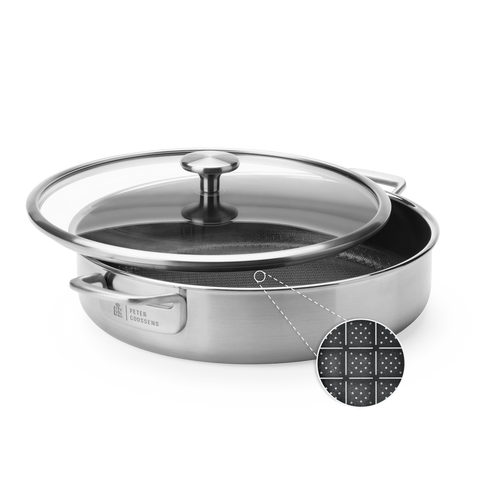
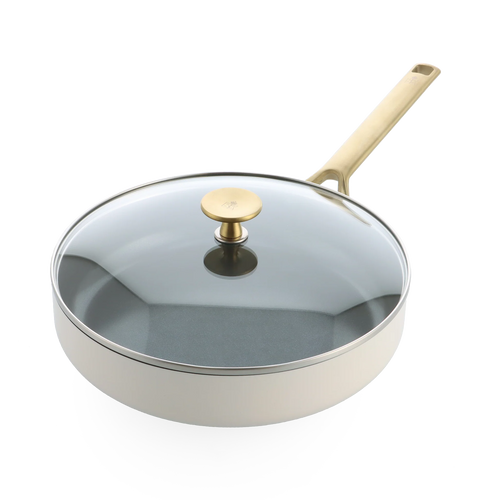
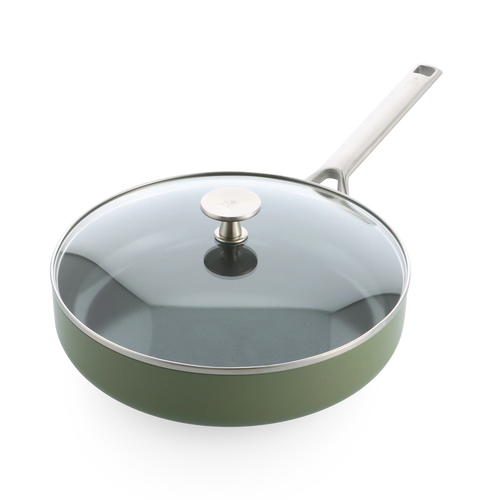
Each brand in this overview has its own focus. Greenpan is the pioneer of the ceramic non-stick coating and was the first in the world to bring the Thermolon coating to market in 2007; the brand has the most complete ceramic range, from the compact Geneva and the spacious Première to the colorful Padova Skyblue and the best-selling Barcelona Pro with an extra wear-resistant Thermolon coating. The Demeyere Alu Pro 5 Ceraforce is a lightweight aluminum pan with a PFAS-free Ceraforce coating that, according to the manufacturer, is up to 30% more energy-efficient on induction and provides an affordable way to cook with Demeyere. Le Creuset brings its quality standards to ceramic with the Essential Ceramic Non-stick and the Provençal Sauteuse with glass lid. Smeg adds retro design with its ceramic frying pan in Emerald Green, Cream and Black. The DUCQ Downdraft is designed for kitchens with built-in downdraft extraction, and the BK Durabond Hybride from the Peter Goossens line is the most spacious choice in this range with its Ø30 cm.

Which ceramic saucepan is right for you: size, brand and use

Which ceramic saucepan is the best fit depends mainly on your portion sizes, how intensively you cook and how important style is to you. For 2 to 3 people, a pan with a diameter of 24 to 26 cm is the perfect size; the Greenpan Geneva (Ø24 cm / 2.6 L) and the Greenpan Première (Ø26 cm / 3.8 L) are excellent all-rounders. If you cook for a family or want more room for sauces and larger dishes, Ø28 cm is the standard: the Greenpan Barcelona Pro (also available in Ø28 cm) and the Smeg (Ø28 cm / 4.3 L) are popular choices, and for the largest portions, there is the BK Durabond Hybride in Ø30 cm. For those who value a lightweight and energy-efficient pan for induction cooking, the Demeyere Alu Pro 5 Ceraforce is a strong, affordable option. And if style and quality are equally important to you, the Le Creuset Essential Ceramic and the colourful Smeg pans will be an eye-catcher on the stove. If you are still unsure, our blog which pan do I need? will help you.

This is how your ceramic saucepan will last longer

Ceramic coatings last the longest when you treat them properly, and most complaints about "sticking" can be avoided with a few habits. Cook over low to medium heat: ceramic heats up quickly, and overheating is the fastest way to weaken the non-stick coating. Never heat the pan empty and use a small amount of oil or butter instead of aerosol cooking sprays; they leave an invisible layer of residue that actually causes sticking over time. Preferably wash the pan by hand with a soft sponge and mild dishwashing liquid, even if the model is officially dishwasher-safe, and use wooden, silicone or plastic utensils instead of metal. Let a hot pan cool down briefly before rinsing it to prevent thermal shock. With this care, a ceramic saucepan will last beautifully for several years. You can find more tips in how do I care for my pans?