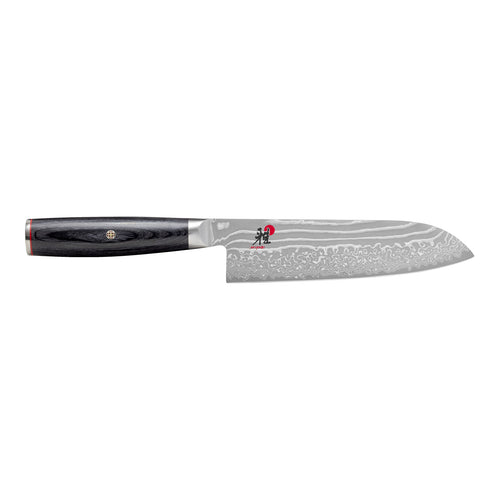
MIYABI 5000FCD Shotoh - Utility knife 14cm

MIYABI 5000FCD Shotoh - Utility knife 14cm
Kern van FC61-staal, ca. 61 HRC
Damastpatroon met 49 lagen staal
Met de hand geslepen volgens Honbazuke in Seki, Japan
 Shotoh 14cm
Sold out
179,00


Free shipping
Levenslange garantie bij huishoudelijk gebruik warranty on this product
Free returns within 60 days
3+ units? Contact us for a quote

About MIYABI
It takes 100 steps and 42 days to create a knife worthy of the Miyabi name. Each knife passes through the hands of experienced artisans before reaching you, ensuring you always receive the best quality. Our knives are made in Seki, which has been Japan's epicenter for sword making since the 14th ...
View all MIYABI products
Goes well with this
Current product MIYABI 5000FCD Shotoh - Utility knife 14cm – Default Title
 MIYABI 5000FCD Shotoh - Utility knife 14cm – Default Title
Product information
Small knife, big mouth. The MIYABI Kaizen II 5000FCD Shotoh 14 cm is the knife for everything too small for your chef's knife and too important for a cheap paring knife. Fruit, vegetables, shallots or a piece of meat: it doesn't even blink.
Shotoh: the knife that never leaves the counter
Shotoh loosely translates as 'small knife', but don't underestimate it. With a 14 cm blade it is the ideal all-rounder for fine cutting, peeling, pitting and neatly trimming vegetables and meat. It feels light in the hand, is as nimble as a street fighter and as precise as a surgeon. Precisely because you use it so often, you'll feel the difference of top-grade Japanese steel every day.
FC61 steel in 49 layers of Damascus
The MIYABI Kaizen II 5000FCD proves that top Japanese quality doesn't have to be unaffordable. The core is made of fine FC61 steel, surrounded by 48 layers of steel that together form a beautiful Damascus pattern. Thanks to FRIODUR ice-hardening the blade reaches a hardness of around 61 HRC, so the edge is razor-sharp from day one and stays that way for a long time. The three-stage Honbazuke process (grinding, sharpening and polishing) completes it.
Black pakkawood, seamlessly finished
The black pakkawood handle is perfectly balanced and finished with a steel end cap, a decorative mosaic pin and a decorative ring. The transition from handle to blade is seamless, so you won't get calluses on your thumb and index finger. Because there's no finger guard, you can use the full length of the edge. Ground symmetrically and therefore suitable for left- and right-handers. Handmade in Seki, Japan.
Craftsmanship in numbers
The facts at a glance: blade 13.9 cm, total length 26 cm, handle 11.5 cm, weight 100 grams. The blade is made of FC61 steel with a hardness of around 61 HRC. Light enough to work with for hours, heavy enough to feel you're holding something good.
How to keep it sharp
A knife of this calibre doesn't belong in the dishwasher. Wash it by hand with warm water and a mild detergent and dry it straight away. Use a wooden or plastic cutting board and leave glass, stone and ceramic well alone. Sharpen it on a whetstone, for example the MIYABI whetstones #400, #1000 and #5000. Store it in a knife block or on a magnetic strip, not loose in the drawer. Treat it with respect and it will stay loyal for years.
Frequently asked questions
-
Wat maakt de MIYABI Kaizen II 5000FCD bijzonder?
-
Mag een MIYABI-mes in de vaatwasser?
-
Hoe houd ik mijn MIYABI-mes scherp?
-
Is dit MIYABI-mes geschikt voor linkshandigen?
-
Op welke snijplank gebruik ik een Japans mes?
-
Hoeveel garantie zit er op MIYABI-messen?
Pros
Kern van FC61-staal, ca. 61 HRC
Damastpatroon met 49 lagen staal
Met de hand geslepen volgens Honbazuke in Seki, Japan
Sizes
| Blade length (cm) | 13.9 |
|---|---|
| Blade height (cm) | 3.9 |
| Handle length (cm) | 11.5 |
| Height (cm) | 3.9 |
| Width (cm) | 1.8 |
| Length (cm) | 26 |
| Weight (g) | 100 |
Product specifications
- Warranty
- Levenslange garantie bij huishoudelijk gebruik
- Origin
- Japan
- Series
- 5000FCD
- Material
- FC61 staal
- Handle material
- Pakkahout
- Rockwell hardness
- 61.0 HRC
- Steel type
- FC61
- Sharpening angle
- 20 degrees
- Left- or right-handed
- Beide
- EAN
- 4009839376887
- Article number
- 34680-131-0
Related products
More officemessen


Often bought together
Everything for the home chef